
Empty Space Is Full of Everything
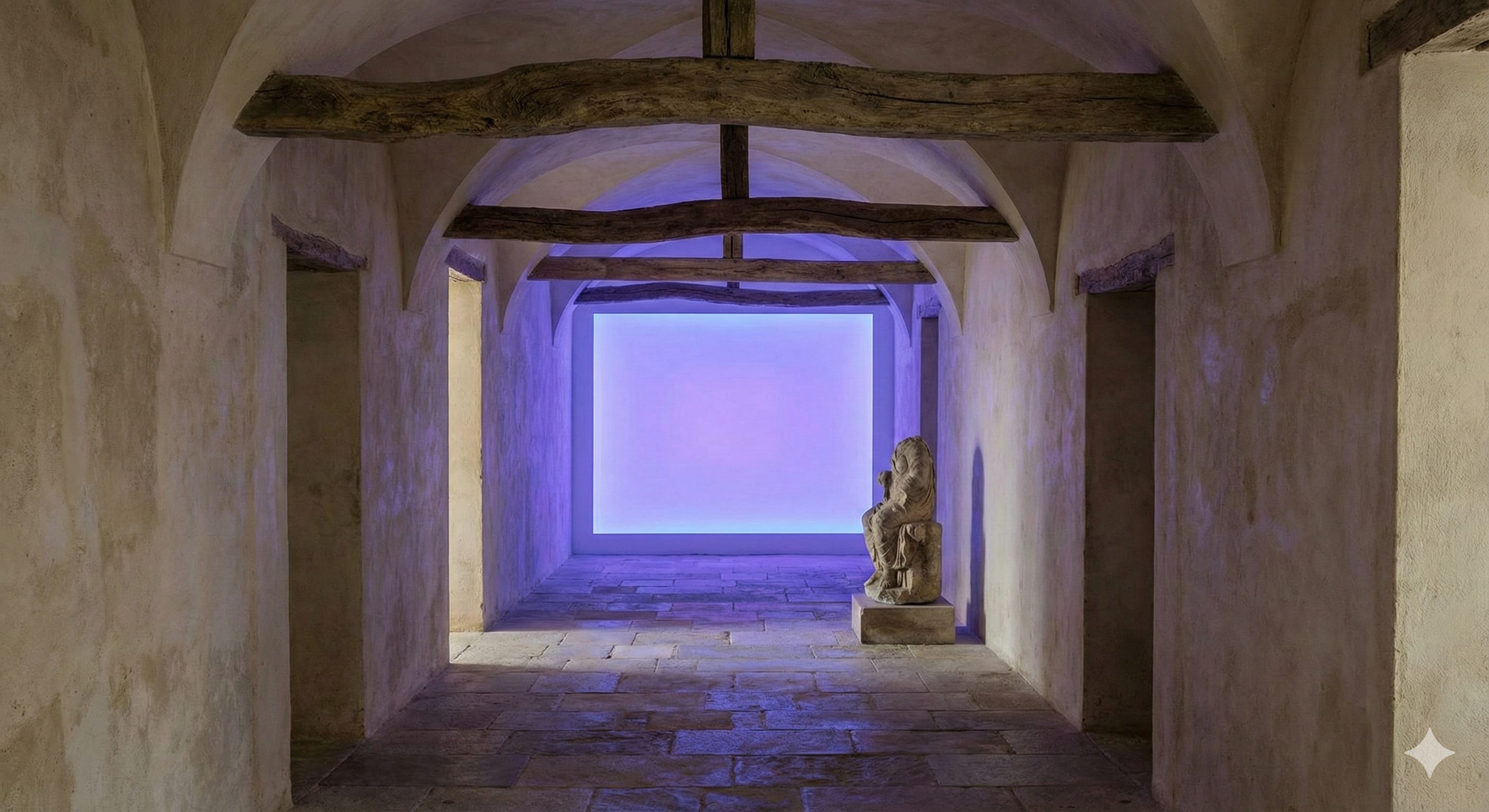
Once upon a time, in a land not so far away, I was a record producer. As idyllic as that sounds, it mostly meant late nights working in dark rooms with no windows, trying to pull magic out of thin air. Creation, at least in that world, was always about adding. More strings, another lead line, one more layer to make it feel finished.
It took me years to realize that sometimes less really is more.
When I listen back to records I worked on, I am often shocked by how much I tried to cram in. And when I open old unfinished sessions just to scratch the itch, I usually end up deleting entire sections. What remains suddenly breathes.
There is a particular ritual that happens in studios when you get a bunch of music folk together. You sit around in silence, leaning back in rolling chairs, listening to records you love. No one really talks. You are not dissecting yet, just absorbing and hoping to get some of the magic through some sort of art osmosis. Over time, I noticed something consistent. The records that stayed with me were not the densest or most technically impressive ones. They were the ones that left room. Space between elements. Moments where nothing happened and yet everything was happening.
In those gaps, my mind went to work. I filled them without realizing it. Slowly it became clear that everyone else in the room was doing the same thing, each of us hearing something slightly different, each of us completing the record in our own way. I promise this was also in absence of the Mary Jane although it has its benefits musically but that is a topic for another day.
That realization applies to every form of art. What a song sounds like to me, or what a painting reveals to me, might be entirely different for someone else because the work allows for it. The artist does not disappear in this process. They simply stop over explaining.
This is why Quentin Tarantino never shows what is inside the suitcase in Pulp Fiction. Everyone leaves with their own answer. As he put it, if a million people see my movies, I hope they see a million different movies.
The brain is built for this. There is a theory called Gestalt, developed by a group of slightly eccentric German psychologists in the early twentieth century, which already tells you a lot, as most modern scientific ideas seem to emerge from that exact time and place. It suggests that the human mind does not experience the world as a collection of separate parts, but as unified wholes. We do not hear individual notes, see isolated shapes, or register fragments of information. We assemble them into meaning automatically, often without realizing it. When an artist leaves a gap the brain jumps in to complete the story. The absence becomes participatory. The observer steps in and finishes the work.
This is also why cluttered art feels suffocating while sparse work feels expensive. It comes down to figure ground relationship. When everything insists on being the focal point, nothing can breathe. Remove the excess and the subject finally has context.
Gestalt theory also gives us the Law of Prägnanz, which says that the brain prefers things to make sense with as little effort as possible. Although everyone has an ex or two that would refute that theory. Outliers aside faced with complexity, the mind instinctively looks for the simplest, most stable interpretation of what it is seeing or hearing. It wants clarity, balance, and resolution. When a work is overloaded, the brain has to work harder than it wants to, which eventually feels tiring. When a work is reduced to its essential parts, the experience becomes effortless. Meaning emerges without force.
This is why empty space in art is never empty at all. It is full of the viewer.
Physics arrives at the same conclusion. In modern physics, empty space is not empty. A vacuum (not the one in your house that you use on your dirty floors) is filled with fluctuating energy, particles appearing and disappearing, potential constantly in motion. The void is full of possibility. Art works the same way. The space left in a piece is not missing content. It is stored energy, waiting to be interpreted by the observer.
Space allows time for perception to settle. It creates anticipation. Think of the silence before the iconic drums in Phil Collins “In the Air Tonight.” That sparse soundscape before is doing as much work as the drum sounds that follows.
This logic extends beyond art. Architecture and design follow the same principles. Anyone old enough to remember the pre iPhone era knows how overwhelming interfaces once were. Endless menus, endless decisions. The original iPhone felt revolutionary because it removed friction and created space.
Legendary architect Frank Lloyd Wright understood this intuitively. He compressed entryways before opening them into expansive living rooms. A physical buildup and release. An architectural version of a drum roll before a drop.
In the end, the hardest part of making anything is deciding where to leave space.
This is why space is also often misunderstood. Everyone knows someone with an empty house that calls themselves a minimalist. A single chair in a living room does not create minimalism any more than silence creates music. That’s as ridiculous as someone sitting on stage with a guitar in silence claiming to play a song. Space works when it is intentional, directs attention, and gives structure to what is around it.
The placement of space determines whether a work feels unfinished or resolved. When used well, space carries as much weight as any material element. It shapes rhythm, controls focus, and holds everything together.
This applies to humans as well. Michelangelo believed the statue already existed within the stone. A person is no different. Form appears through subtraction, and that is when most people start arguing with the chisel.
Knowing where to place that space is the art. Chisel away.