
The Landlord Special: How AI Is Being Painted Over Rotting Business Models
There’s a term anyone who’s ever rented an apartment knows too well: the landlord special. It’s when a landlord doesn’t actually fix anything, they just paint over the damage. Mold? Painted white. Rotten floors? Covered with stick-on vinyl. Cracked countertop? Caulked and re listed as “new kitchen.” From the photos, it looks “renovated,” but the plumbing still leaks and the foundation still sags.
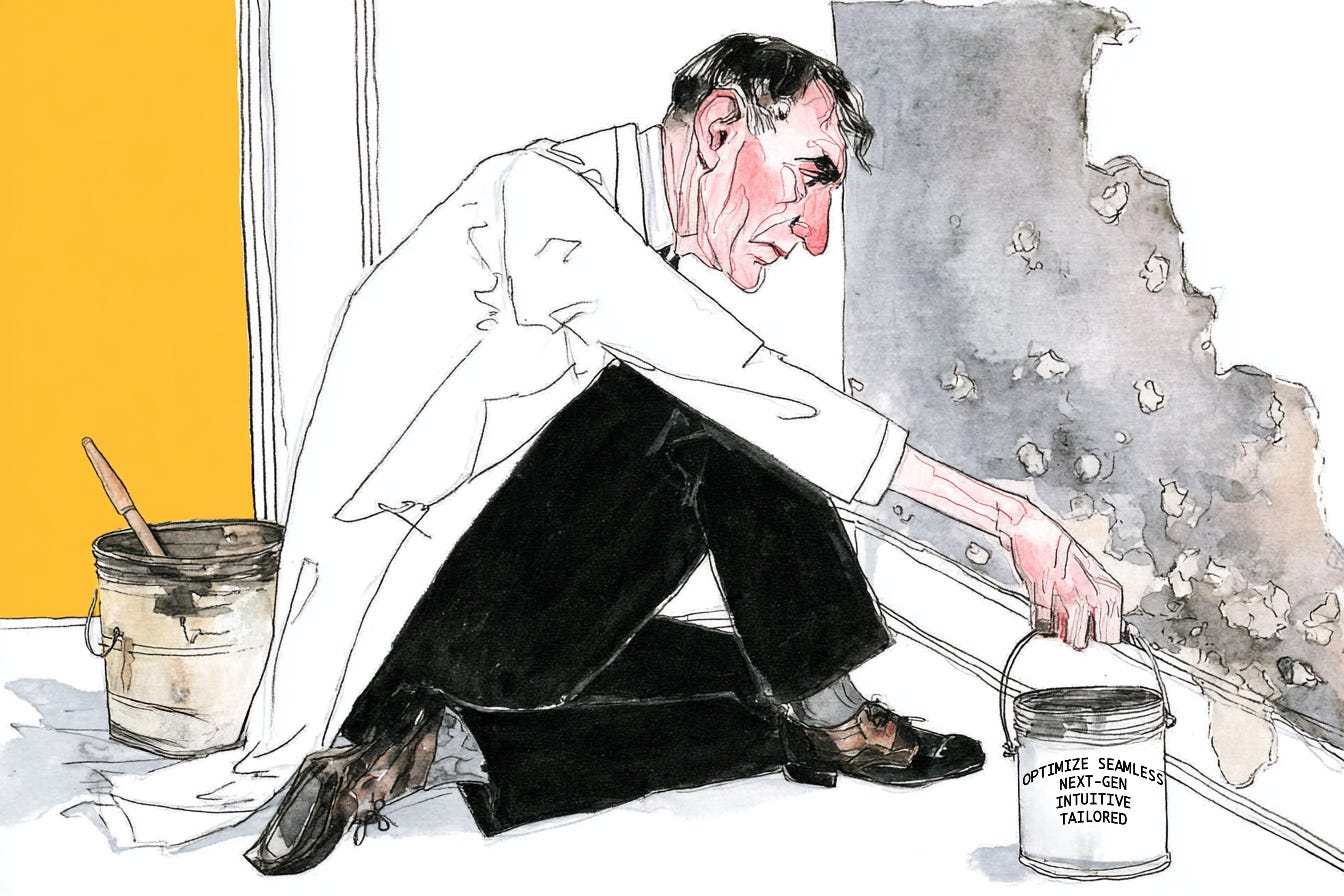
Walk through any airport or train station and you’ll be harassed by the AI ads with the same five words: optimize, seamless, next-gen, intuitive, tailored. They don’t show new capabilities or real outcomes, just rebranded buzzwords slapped like plastic trim over ancient infrastructure.
This is exactly what’s happening with AI across the corporate world. Companies aren’t building new technology, they’re slapping “AI” over outdated systems the way a landlord paints over water damage and calls it “luxury”.
This is not an anti-AI take. Quite the contrary. The true AI revolution is very real. It will change everything. But what we’re being marketed right now? Landlord specials in digital form.
Steve Jobs once said: “When the sales guys run the company, the product guys don’t matter so much.” And at the moment they are running the show but only for so long.
Replacing a call center with a chatbot isn’t innovation, it’s the corporate version of covering a broken tile with a rug. It doesn’t solve the problem. It just hides the human cost and calls it efficiency. Everyone can relate to the to the image of yelling “representative” to the phone.
Real innovation doesn’t require marketing buzz to announce itself. It works, and people adopt it because it actually changes reality. Sure you might need some cool ad campaigns to get it moving but ultimately if it doesn’t work it won’t work at a macro level. The louder the language, the cheaper the renovation. Regardless of what you think of Elon Musk, one thing is undeniable: SpaceX actually executes. They don’t run glossy ads telling you how “seamlessly optimized” their launch architecture is. They don’t fill airports with buzzwords about next-gen synergies. They don’t need to. You’re just driving home one evening, and you look up and boom there it is, a glowing arc streaking across the sky. Not a commercial. Not a 30 second ad interrupting your YouTube video. A rocket leaving Earth. That is what real innovation looks like. It announces itself through reality.
If I believed in shorting stocks, at this point I wouldn’t look at actual earnings or balance sheet health. I’d feed an LLM every earnings transcript and flag every company that uses “next-gen AI integration” more than five times. The more a company markets the illusion of transformation, the less transformation is actually happening.
History always flushes out the landlord specials. Shout out Enron.
We’ve also seen the pattern of fear every time a revolutionary technology emerges. The steam engine, electricity, the internet. Each one triggered panic: It will eliminate jobs! It will ruin livelihoods! And it did eliminate some. But it created far more. Historical data from the early industrial era shows that the steam engine increased textile production by more than 200 times in output while the total number of people employed in the textile industry increased tenfold over the next 50 years. The technology that was feared for killing jobs actually created entire new sectors of employment, wealth, and human advancement. When Apple shifted from being a computer company to building an entirely new ecosystem around the iPhone it rewrote reality. Nvidia is not dominating today because it marketed itself as “AI enabled,” but because it rebuilt its entire architecture to power machine intelligence. Netflix did not hang a streaming logo over its DVD business. It burned the old model and pivoted completely. Amazon went from selling books to constructing the infrastructure of the internet through AWS. And then there is the flip side. Blockbuster tried to add an online tab while clinging to late fees. Kodak invented the digital camera but never adapted its identity, choosing to repackage film instead of replacing it. Yahoo kept redesigning its homepage while search and advertising quietly passed it by. BlackBerry added random enterprise features to old hardware while Apple built an entirely new era and idea of what a phone is. They tried to caulk and paint their way through technological shifts and it worked for a while but eventually the cracks showed.
History rewards the builders. It forgets the landlords.
A new wave of corporate extinction is coming. The companies merely taping AI-shaped vinyl over outdated business models will not make it through. Standard & Poor’s data show that the average lifespan of companies listed in the S&P 500 was 61 years in 1958, 25 years in 1980, and 18 years in 2011 and is closer to 15 years today. Expect AI to keep driving that down faster. Think I am merely inferring the future the way someone who sees seven sunny days assumes the eighth will be sunny too? A 2024 Stanford AI Index study found that mentions of “AI” on S&P 500 earnings calls have increased by more than 500 percent over the past five years, yet only 6 percent of those companies reported any measurable productivity gains from AI deployment. A study by MSCI found that companies that use the most AI buzzwords in earnings calls under perform the market by an average of 5.8% over the following year. The way companies are using “AI” right now is the corporate equivalent of someone saying “trust me bro.” The moment you hear it, you know you shouldn’t.
The Truth About Jobs and Fear
We keep hearing, “AI will eliminate jobs.” Awesome! Why are we fighting to preserve warehouse jobs that destroy your back for minimum wage? Is that the human destiny we’re protecting? AI won’t end human creativity, it will demand more of it. It will strip away the illusion of work and expose where real value comes from. Any job that can be automated should be, because it means humans can return to what we actually do best: invent, create, reason, build, dream.
The real divide won’t be human vs AI. It will be builders vs lazy landlords. One group is building the architecture of the future. The other is busy staging an open house with silly buzzwords like “modern updates” and “rustic touches”.